







By Joanne Van Voorhis
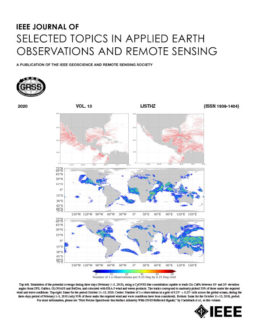
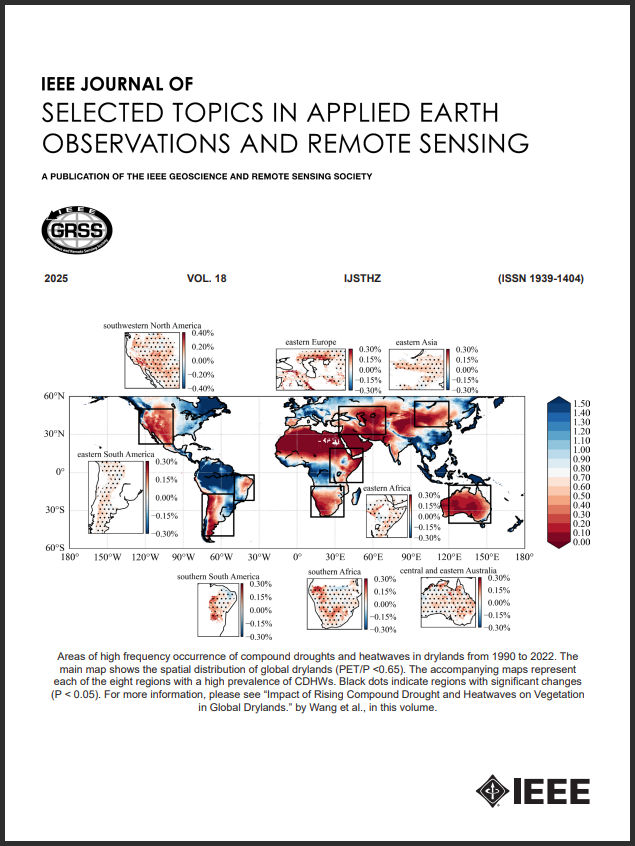 As part of our continuing series highlighting the publications that define communication within the IEEE Geoscience and Remote Sensing Society, today we feature a journal that captures the field’s applied momentum. IEEE JOURNAL OF SELECTED TOPICS IN APPLIED EARTH OBSERVATIONS AND REMOTE SENSING (J-STARS). (J-STARS) stands as a central platform for demonstrating how remote sensing innovations translate into real-world solutions.
Origins: Aligning Remote Sensing with Global Application Needs
J-STARS launched in 2008 during a period of major change in Earth observation. Remote sensing was evolving from a field focused mainly on experimental missions and isolated studies into a practical tool for addressing real-world problems at global scale. At the same time, initiatives such as Global Earth Observation System of Systems (GEOSS) were encouraging international coordination and data sharing, while new satellite missions and sensors were generating larger and more diverse datasets. Together, these developments created growing expectations that remote sensing should deliver actionable information as well as technical innovation.
Within this context, IEEE GRSS recognized a gap in its publication portfolio. From its inception, J-STARS drew upon the experience of the highly successful “IEEE TRANSACTIONS ON GEOSCIENCE AND REMOTE SENSING” and provided a complementary medium for the wide range of topics in applied earth observations.

“From the outset, its purpose was not to compete with existing journals, but to complement them by focusing on Earth observation applications and applied remote sensing research,” explains Professor Peifeng Ma, Editor in Chief (The Chinese University of Hong Kong).
“In addition, the goal of the journal is to publish very quickly,” he adds. “Our rapid peer review process is now targeting a publication time frame of 10 weeks for most accepted papers.”
Charter: The “Selected Topics” Model
The defining feature of J-STARS is embedded in its name: “Selected Topics.” Unlike traditional journals that publish continuously across all areas of a field, J-STARS organizes much of its content into thematic issues dedicated to specific application areas. Topics are carefully chosen to reflect emerging scientific, technological, and societal priorities. Examples include environmental monitoring, precision agriculture, urban analytics, disaster response, cryosphere studies, ocean observation, and climate change impacts. Each theme is typically developed through a coordinated call for papers, often aligned with GRSS technical committees, workshops, or major international conferences.
“This structure gives J-STARS a unique role,” says Professor Ma. “J-STARS functions not only as a journal, but also as a curated snapshot of where the field is heading. Each special issue effectively becomes a focused collection of state-of-the-art contributions, providing readers with both depth and coherence on pertinent topics.”
“The journal’s mission emphasizes application-oriented remote sensing research, integration of diverse sensing and modeling approaches, and the use of Earth observation technologies to address environmental and societal challenges,” Professor Ma explains. This focus distinguishes J-STARS from more generalist outlets. The emphasis is on how remote sensing is used in practice to solve real problems.
Inaugural 2008 Issue: Renewable Energy
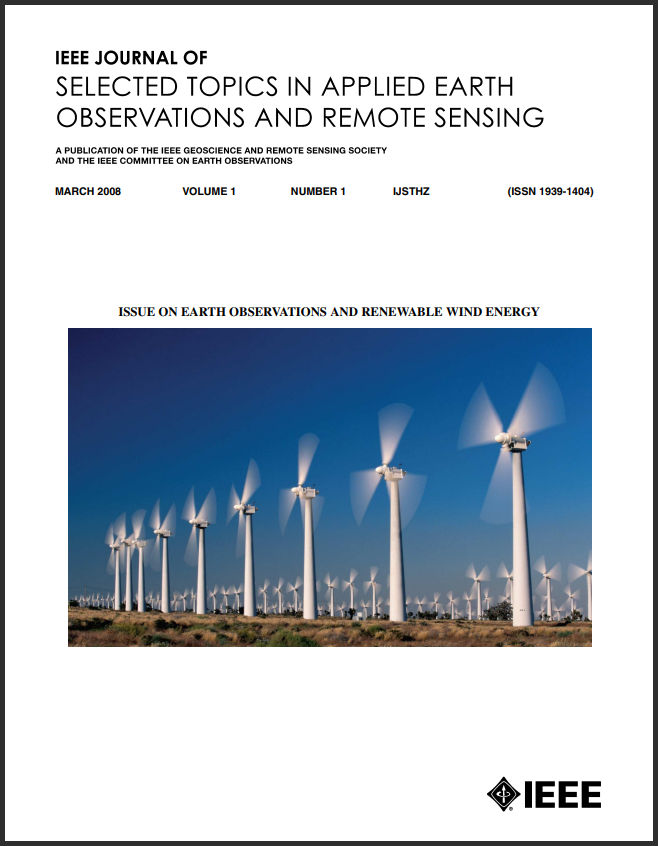
The eight papers in the March 2008 inaugural issue focused on earth observations and renewable energy. The forward explained the rationale for the selected topic: “In focusing on Renewable Energy and Earth Observations for this inaugural issue of the new IEEE Journal on Selected Topics in Applied Earth Observations and Remote Sensing (J-STARS), we are enhancing the new vision brought by remotely sensed technology applied to our understanding of the Earth. An awareness of the various impacts that Energy has on climate change will lead to a modification in our behavior. This will be one of the most important of a range of responses to the impact of climate change on society. Hence, through this special issue, our objective is to propose new ways of dealing with energy and, particularly, renewable energy by taking advantage of all the advantages that Earth observations and remote sensing provide.”
Editorial Leadership and Stewardship
The editorial structure of J-STARS reflects its thematic mission. Since its founding, the journal has been led by Editors who have emphasized both scientific rigor and application relevance. A key feature of the editorial model is the use of guest editors for special issues. These guest editorial teams are typically composed of domain experts responsible for shaping the scope, soliciting contributions, and guiding the review process for specific thematic collections. This distributed model allows the journal to remain highly responsive to emerging trends while maintaining strong subject-matter expertise.
“The Editorial Board includes volunteer experts from many fields whom we rely on to support J-STARS throughout the year,” says Professor Ma. “This is truly a team effort, with the support of volunteers from around the world who contribute their time, expertise, and enthusiasm to advance the journal.” Accordingly J-STARS has developed a broad and dedicated international Editorial Board, reflecting the global nature of Earth observation science. Associate editors span academia, research institutions, and applied sectors, ensuring that submissions are evaluated from both methodological and practical perspectives. This structure is essential to the journal’s identity: it enables J-STARS to function as a coordinated platform for thematic synthesis at global scale.
Thematic Depth and Focus
Unlike journals organized purely by discipline or methodology, J-STARS content is structured around application ecosystems. Each special issue typically brings together contributions that address a common problem from multiple angles. For example, a special issue on urban remote sensing might include papers on high-resolution image analysis, socioeconomic mapping, infrastructure monitoring, and machine learning approaches for land-use classification. This diversity within a unified theme allows readers to gain a comprehensive understanding of how different techniques converge on a shared application. J-STARS also publishes regular papers outside special issues, maintaining a continuous submission model alongside its thematic collections. Current planned special issues are available online and include:
- “Hyperspectral AI”
- “WSF-M Mission and Calibration/Validation”
- “Multimodal Reasoning Models in Remote Sensing”
- “Geology-1 Hyperspectral Satellite: Innovative Methods and Applications”
- “Advances in Multimodal Transfer Learning for Remote Sensing”
- “AI-Driven Multimodal Remote Sensing for Forestry Monitoring and Management”
- “Recent Advances in Automatic Multimodal Remote Sensing Image Registration”
- “Towards Semantic and Reasoning-Enabled Remote Sensing: Vision-Language Models for Retrieval, Interpretation, and Interaction”
- “Advances in Microwave Remote Sensing of the Cryosphere”The journal also continues to organize special issues around major conferences and emerging satellite missions.
Responding to Emerging Global Challenges
One of J-STARS’ most important roles is its responsiveness to emerging global challenges. Because its structure is thematic, the journal can rapidly assemble collections focused on new or evolving issues. This agility allows it to reflect shifting priorities in climate science, sustainability, and technological development.
“Several emerging topics are attracting significant attention in JSTARS due to their relevance to global challenges,” says Professor Ma. “These include monitoring climate change, wildfires, and natural disasters using Earth observation data. We are also seeing rapid growth in AI enabled remote sensing, including foundation models, multimodal learning, and onboard satellite intelligence. Looking ahead, space ground collaborative computing and near real time Earth observation are promising areas that we hope to feature more prominently in the journal,” he explains.
Encouraging Global Submissions
“We welcome individual articles as well as proposals for theme issues we have identified or special issues on topics relevant to J-STARS,” says Professor Ma. “We seek to present a wide range of emerging technologies and real world applications that demonstrate the value of remote sensing in addressing scientific and societal challenges,” he adds. “The process is straightforward, and since January 2020, J-STARS has operated as a fully open-access journal,” he adds.
Manuscripts are submitted electronically, undergo rigorous peer review, and, once accepted, are published as fully open-access articles for broad visibility within the global research community. For manuscripts currently submitted, the article processing charge is US$1800, with institutional or grant support encouraged. Authors can find more detailed formatting and submission guidelines at J-STARS Information for Authors.
“I would like to encourage researchers from around the world, especially early career researchers, to consider JSTARS as a platform for sharing their latest innovations and applications,” says Professor Ma. “We particularly welcome contributions in emerging areas such as AI enabled Earth observation, climate resilience, and next generation satellite technologies. The continued success of JSTARS depends on the collective efforts of our global community,” he adds.