







By Joanne Van Voorhis

For more than six decades, the IEEE Transactions on Geoscience and Remote Sensing (TGRS) has served as the intellectual cornerstone of the IEEE Geoscience and Remote Sensing Society. Long before “remote sensing” became a widely used term, the journal provided a forum where engineers and scientists could rigorously explore how electromagnetic measurements could be used to understand the Earth and its environment.
First published in December 1963 under the title IEEE Transactions on Geoscience Electronics, its early issues reflected a young field focused on radar, radiometry, and instrumentation – topics that would later underpin satellite Earth observation as we know it today. When the journal adopted its current name in 1980, it formally embraced the expanding scope of geoscience and remote sensing, aligning itself with a rapidly growing global discipline.
Technical Rigor and Depth
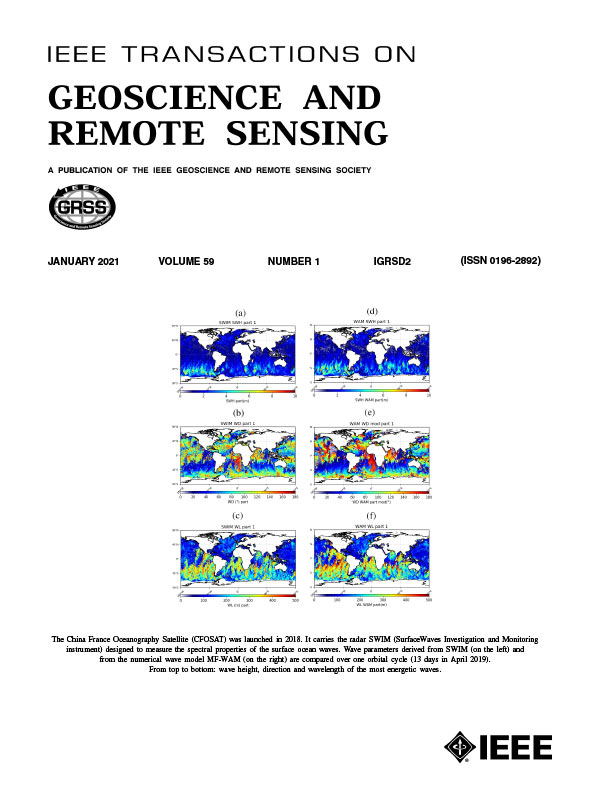
From the outset, TGRS established a reputation for technical rigor and depth. Early papers addressed foundational problems – scattering theory, calibration, sensor design – that remain relevant today, even as methods and platforms have evolved dramatically. Over time, the journal published many of the field’s most important advances, including the transition from airborne experiments to spaceborne missions or UAV programs, and from single-sensor studies to integrated, multi-modal Earth observation systems.
Today, TGRS reflects the extraordinary breadth of modern geoscience and remote sensing. Its pages encompass theory, concepts, and techniques of science and engineering as applied to sensing the land, oceans, atmosphere, and space and the processing, interpretation, and dissemination of this information.The sensing modalities include both passive or active data collection over optical, thermal and microwave wavelengths, such as multi/hyperspectral imaging, LiDAR, SAR, GNSS-R and seismic data. Equally important, the journal has evolved alongside the computational revolution, publishing work on information retrieval with machine learning and artificial intelligence algorithms.

“This breadth is one of TGRS’s defining strengths,” says Dr. Xiuping Jia, the Editor-in-Chief. “It remains grounded in physical principles while welcoming innovation in algorithms, data processing, and system design to achieve the transformation of remote sensing raw data to information and action. As a result, we are pleased to attract contributions from researchers working at every level of the remote sensing enterprise – from fundamental electromagnetic theory to large-scale environmental monitoring and Earth-system science,” she adds.
Impact on the Global Remote Sensing Community
The influence of TGRS extends well beyond its pages. Articles published in the journal inform satellite mission design, algorithm development, and operational Earth observation programs. They shape conference discussions at IGARSS and other workshops, guide doctoral research, and provide reference points for interdisciplinary collaboration. For GRSS members, TGRS is a trusted technical resource, connecting members working in diverse subfields through common interests. For the broader scientific and engineering communities, it remains a trusted source of authoritative work in geoscience and remote sensing.
Expanding Author Diversity Through New OPC Policy
As part of its ongoing evolution, TGRS has recently increased its Overlength Page Charge (OPC) threshold from six pages to ten pages. The expanded OPC threshold is particularly meaningful for early-career scientists and for authors from regions where publication costs can be a limiting factor. “We are pleased with this change in OPC thresholds,” says Dr. Jia. “This paves the way to strengthen TGRS’s role as an inclusive, global forum for high-quality research.”
Growth and Editorial Stewardship
The strength of TGRS is evident in its increasing number of submissions. “The number of submissions in 2025 exceeded 10,000, a quantity that reflects both the expansion of the field and the journal’s standing within it,” explains Dr. Jia. Managing this growth requires careful editorial stewardship and the sustained efforts of a large volunteer community, including the Editor-in-Chief, Deputy Editors-in-Chief, Associate Editors and Reviewers. The process of reviewing and editing is achieved through the dedication of these GRSS volunteers, who each play a critical role in maintaining the journal’s quality and value with an acceptance rate of <30%.
“Active scholars are most welcome to volunteer to be reviewers to support the advancement of the field,” encourages Dr. Jia. You may indicate your specific areas of expertise and your willingness to serve as a reviewer by registering as a new user online. In addition, existing reviewers may update their profiles online to assist with the effective peer review process.
TGRS Looks to the Future

As Earth observation continues to grow in impact – driven by environmental, societal, and technological advances – IEEE Transactions on Geoscience and Remote Sensing reflects not only progress in technology, but also the GRSS community’s shared commitment to rigorous science, thoughtful review, and global collaboration.
“More than six decades after its first issue, TGRS continues to play a leading role in involving and engaging researchers around the world,” says Dr. Jia. “We strongly advocate broader validation and adoption of the advanced developments published at TGRS across diverse Earth observation applications. The goal of TGRS is to serve as an influential platform by engaging a wider audience of readers and implementers to shape the future development of remote sensing for geosciences,” she adds.
View the latest issue, as well as previous issues of TGRS here: