



By Stephanie Tumampos
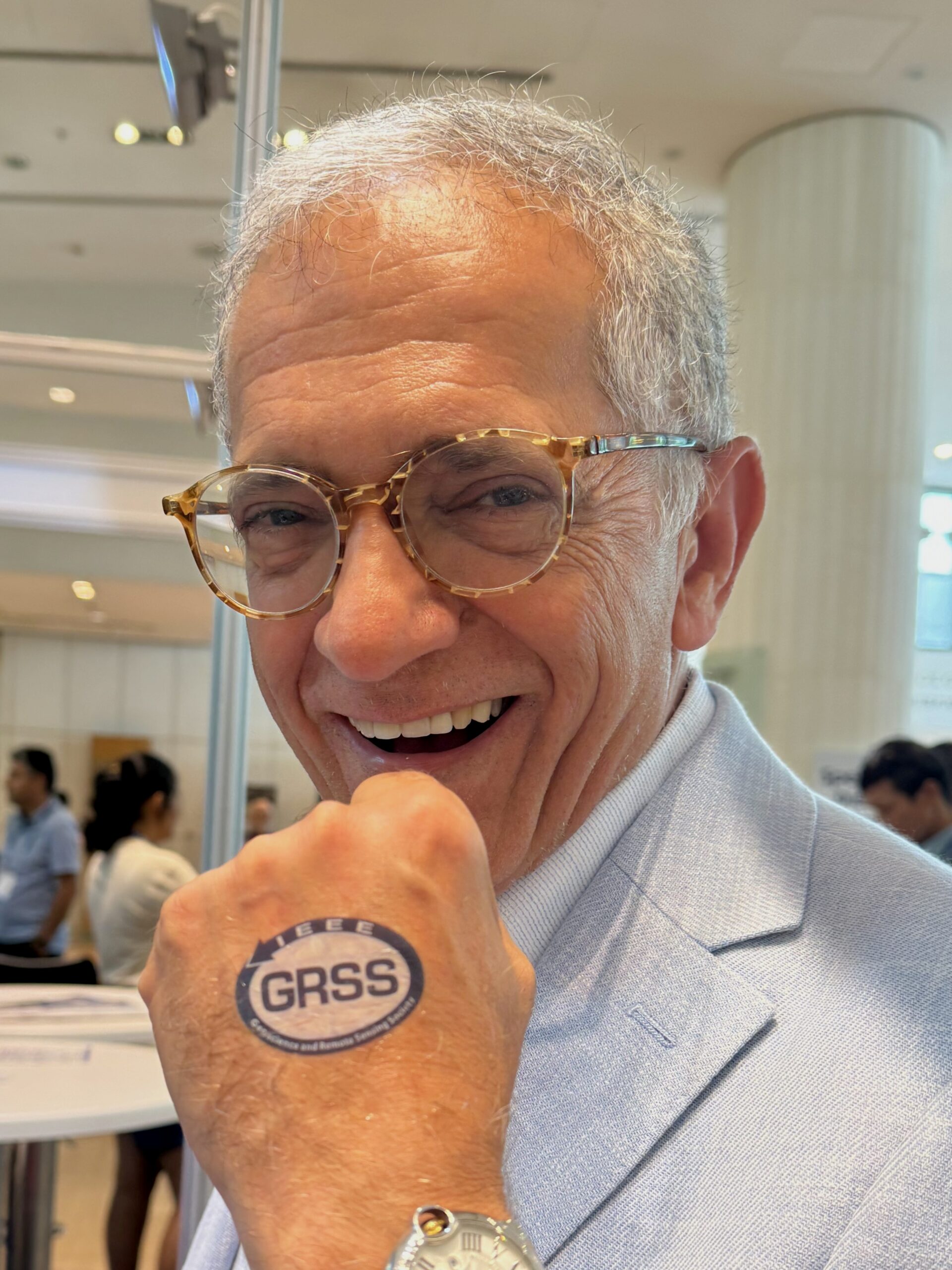
This year, Prof. Kamal Sarabandi found himself again on a stage of both humility and honor as he graciously accepted another prestigious award from the Institute of Electrical and Electronics Engineers (IEEE), the 2025 IEEE Dennis J. Picard Medal for Radar Technologies and Applications.
In this exclusive feature, we delve into one of IEEE GRSS Past Presidents and Awardee, on his remarkable journey of humble beginnings to groundbreaking research, leading to another IEEE award recognizing his expertise in the theory and applications of radar technologies.
In the realm of remote sensing, signals fade quickly with distance. In radar, this is known as path loss. The unforgiving 1/R4 drop-off weakens echoes of signals as they travel to and from a target, burying valuable information beneath layers of noise. And the answer to this challenge has always been gain: through ingenuity and signal processing. Scientists pull faint whispers from the noise and amplify what nature tries to conceal.
Few have mastered this art like Kamal Sarabandi. For decades, his work centered on turning the faintest echoes into meaning – on transforming loss into signal.
Like remote sensing, life also has a path loss. Ironically, Sarabandi’s life mirrors the very phenomena he studies. His journey, too, has been marked by distance, attenuation and perseverance – signals of opportunity that once seemed too weak to detect, until persistence and purpose amplified them.
“I arrived at the University of Michigan on February 28, 1984. It was a leap year that’s why I remember,” he recalled.
When the Iran-Iraq war broke out in 1980, Sarabandi had just earned his bachelor’s degree. Drafted into the Iranian military, he spent three years in conflict – a test of endurance that made survival only the first victory. When his service ended, he seized the chance to pursue higher education abroad. Because Iran had no U.S. embassy, he traveled to Germany to obtain a visa for the United States—a process filled with uncertainty and long waits. For forty days, he remained in limbo until the approval finally came.
The next challenge was finding the right graduate school that didn’t require the GRE, which wasn’t available in Iran at the time. And as Sarabandi describes it, “If you just try, sometimes nature helps you.” And indeed, fortune did. The University of Michigan opened its doors to him and with it, a defining mentorship under Professor Fawwaz T. Ulaby, the visionary who transformed the IEEE Geoscience and Remote Sensing Society (IEEE GRSS) to what it is today.
“One of the best pieces of luck in my life,” Sarabandi reflected, “was that at the same time, Professor Ulaby moved from Kansas to Michigan.”
From that moment, a career of remarkable impact unfolded. Sarabandi became one of the foremost figures in radar remote sensing, credited as the first to establish the connection between the incoherent and coherent domains of radar polarimetry. He has authored over 1,000 papers, co-founded the high-tech company EMAG Technologies, and led IEEE GRSS as its president from 2015 to 2016.
This year, his lifelong contributions were recognized with the 2025 IEEE Dennis J. Picard Medal for Radar Technologies and Applications—an honor he describes with quiet pride and humility.
“I’m very pleased to have received this award and I’m honored by it,” he expressed, acknowledging the significance of the recognition.
In a candid reflection on his journey, Sarabandi also expressed both his surprise and gratitude for the award. “At the onset, when I started my career basically and through this very long journey of education and doing research, I never thought that I would be receiving an award like this,” he mused.
Sarabandi also revealed that his motivation is deeply rooted from his unrelenting curiosity – a need to understand, to discover, and to solve.
“When I look back and try to understand what made me stay in the path for such a long time, this was perhaps my curiosity,” he shared. “The curiosity to discover new processes, to find out why something happened,to understand the root cause of any phenomenon and to see if you can use that understanding for the betterment of life on this planet, to help your society and your community.”
And speaking about the outcomes of his curiosity, Sarabandi admitted that these problem-solving moments are, to him, “addictive.” Each problem solved sparks the urge to tackle another. “It fuels you—your curiosity, your motivation, to continue doing the same thing.”
However, it is not only the process that makes it fulfilling for Sarabandi. Beyond discovery and innovation, Sarabandi finds his greatest joy in sharing. Drawing a human parallel, he shares that while many things fade with distance, for him, there are two “signals” in life that if you share, do not fade once it propagates: knowledge and love. For Sarabandi, both defy the conventional rule that sharing diminishes the giver. Instead, these expand and enrich collective understanding. And the stronger they become, the farther it reaches.
“The more you share the knowledge, the level of knowledge goes up instead of being reduced,” he asserted. And akin to the act of sharing knowledge is sharing love. Sarabandi expressed that, “If you give love—to something, to someone—it amplifies. In science and research, this too has positive feedback, an amplification that keeps you going.” This amplification – of signal, of knowledge, of love – is Sarabandi’s ultimate reward.
Prof. Kamal Sarabandi is an IEEE Life Fellow and recipient to 2005 IEEE GRSS Distinguished Achievement Award, 2013 IEEE GRSS Education Award, and the 2024 IEEE Electromagnetic Award, among others.