










Aims and Scope / Call for Papers
EO combines computer vision, machine learning, and signal processing to derive large-scale, consistent information about the Earth surface from airborne and spaceborne sensors. It encompasses a wide range of tasks, including detection, registration, data fusion, and regression across multi-sensor, multi-resolution, and multi-temporal data. Applications span mapping, natural hazards, urban modeling, climate monitoring, and food security. The vast amount of EO data necessitates highly automated scene interpretation workflows. EO directly supports 34 out of 40 UN Sustainable Development Goal indicators, underscoring the relevance of the EarthVision workshop in advancing machine learning-based analysis for societal challenges such as forest fire monitoring, urban growth, deforestation, and climate change.
Automated EO interpretation remains a demanding problem for computer vision due to: (i) complex scene layouts requiring specialized priors; (ii) the diversity of sensors and modalities – such as SAR, LiDAR, and hyperspectral imaging – creating vast, heterogeneous datasets; and (iii) the wide range of spatial resolutions, from centimeters in UAV imagery to kilometers for geostationary satellites. These characteristics make EO data an invaluable test bed complementing standard computer vision benchmarks.
The EarthVision workshop seeks to strengthen collaboration between the EO, computer vision, and machine learning communities, fostering innovation in automated geospatial analysis. By raising awareness of this rapidly evolving and impactful research area, EarthVision promotes the development of scalable, efficient, and trustworthy vision systems that advance environmental understanding and global sustainability.
Given the context of EO, the non-exhaustive list of topics of interest includes:
- Deep learning tailored for large-scale Earth Observation
- Multi-resolution, multi-temporal, multi-sensor, multi-modal processing
- Super-resolution in the spectral and spatial domain
- Hyperspectral and multispectral image processing
- Reconstruction and segmentation of optical and LiDAR 3D point clouds
- Feature extraction and learning from spatiotemporal data
- Analysis of UAV / aerial and satellite images and videos
- Detection, registration, classification, and regression in EO data
- Fusion of machine learning and physical models
- Foundation models and representation learning
- Domain adaptation, concept drift, and the detection of out-of-distribution data
- Self-, weakly, and unsupervised approaches for learning with spatial data
- Data-centric machine learning
- Human-in-the-loop and active learning
- Explainable and interpretable machine learning
- Uncertainty quantification
- Public benchmark datasets, training data standards, evaluation metrics
- Scalable automated EO pipelines
- Fusion of language and Earth observation models
All manuscripts will be subject to a double-blind review process. Accepted EarthVision papers will be included in the CVPR2026 workshop proceedings (published open access on the Computer Vision Foundation website) and submitted to IEEE for publication in IEEEXplore. Publication in IEEEXplore will be granted only if the paper meets IEEE publication policies
Important Dates
All deadlines are considered end of day anywhere on Earth.
| March 2, 2026 | Submission deadline | |
| March 31, 2026 | Notification to authors | |
| April 9, 2026 | Camera-ready deadline | |
June 4, 2026 | Workshop |
Program
| 9:00-9:15 | Welcome and Awards Announcement |
| 9:15-9:45 | Oral Presentations
|
| 9:45-10:20 | Poster spotlights I
|
| 10:20-10:40 | Morning Coffee Break (Note: Coffee is catered 10-11am in Exhibit Hall A, same hall as the following poster session) |
| 10:40-12:00 | Poster session I (Exhibit Hall A – Poster Boards 62 – 68) |
| 12:00-13:15 | Lunch Break (Lunch is served 12:00-13:45 in ExHall C) |
| 13:15-14:00 | Keynote 1 – “From local to global maps from satellite imagery: ML techniques and applications” This talk presents how the Microsoft AI for Good Lab builds geospatial machine learning models and workflows that range from scene level rapid disaster response to global monitoring products. The first part focuses on hyper-local modeling for building damage assessment, where the goal is not broad generalization but fast, scene-specific adaptation to generate actionable maps. The second part shifts to global modeling, where the core challenge becomes validation and robustness across geographies, and time. I’ll highlight three global efforts we work on — Fields of The World, Global Renewables Watch, and TEMPO building density mapping — and discuss what changes when you scale: how you define deployment metrics, how you validate reliably at scale, and how you detect and manage out-of-distribution behavior. Caleb is a Principal Research Scientist in the Microsoft AI for Good Research Lab. His work focuses on tackling large scale problems at the intersection of remote sensing and machine learning/computer vision. At the AI for Good Lab he co-leads the Geospatial ML research group and is the lead researcher on the Global Renewables Watch, rapid damage assessment, and global building density estimation teams. Caleb is interested in research topics that facilitate using remotely sensed imagery more effectively in conservation, sustainability, and damage response application. For example: self-supervised methods for training deep learning models with large amounts of unlabeled satellite imagery, human-in-the-loop methods for creating and validating modeled layers, and domain adaptation methods for developing models that can generalize over space and time. |
| 14:00-14:45 | Keynote 2 – “Simple ideas with big impacts in Computer Vision for Earth Observation” Some of the most consequential ideas in Earth observation AI look obvious in hindsight. Time and again, accessibility, interoperability, and efficiency have determined which models are used in practice — making simplicity an essential design feature, and unlocking new modeling capabilities in the process. In this talk, I’ll trace the evolution of Earth embeddings as a case study in simple ideas with large impact. I’ll then turn to unsolved problems in data-centric computer vision for Earth observation, and make the case that here too, it may be simple solutions that unlock the next wave of advances. Esther Rolf is an assistant professor of computer science at the University of Colorado, Boulder and the AI/ML lead for the Environmental Data Science Innovation and Impact Lab, an NSF data synthesis center homed at CU Boulder. Esther’s research in statistical and geospatial machine learning blends methodological and applied techniques to study and design machine learning algorithms and systems with an emphasis on usability, data-efficiency and fairness. Her lab’s research spans developing algorithms and infrastructure for reliable environmental monitoring using machine learning, responsible and fair algorithm design and use, and the influence of data acquisition and representation on the efficacy and applicability of machine learning systems. |
| 14:45-15:20 | Poster spotlights II
|
| 15:20-15:40 | Afternoon Coffee Break (Note: Coffee is catered 3-4pm in Exhibit Hall A, same hall as the following poster session) |
| 15:40-17:00 | Poster session II (Exhibit Hall A – Poster Boards 194 – 199) |
| 19:00-on | Workshop dinner |

Organizers
- Ronny Hänsch, German Aerospace Center, Germany,
- Devis Tuia, EPFL, Switzerland,
- Jan Dirk Wegner, University of Zurich, Switzerland,
- Loïc Landrieu, IGN, France
- Hannah Kerner, Arizona State University, USA
- Nathan Jacobs, Washington University in St. Louis, USA
Technical Committee
- Aayush Dhakal, Washington University in St Louis
- Alex Levering, VU Amsterdam
- Alexandre Xavier Falcao, IC-UNICAMP
- Anastasia Schlegel, DLR
- Antoine Bralet, Université de Strasbourg, ICube
- Biplab Banerjee, Indian Institute of Technology, Bombay
- Caleb Robinson, Microsoft
- Camille Couprie, Facebook
- Camille Kurtz, Université Paris Cité
- Catherine M Breen, NASA Goddard Space Flight Center
- Christopher R Ratto, JHUAPL
- Ciprian Tomoiagă, AXA
- Claudio Persello, University of Twente
- Clement Mallet, IGN, France
- Conrad M Albrecht, Columbia University
- Corentin Dufourg, Univ. Bretagne Sud / IRISA
- Dalton Lunga, Oak Ridge National Laboratory
- Daniel Iordache, VITO, Belgium
- Diego Marcos, Inria
- Elliot Vincent, Ecole nationale des ponts et chaussées / Inria / IGN
- Emanuele Dalsasso, Inria
- Ewelina Rupnik, IGN
- Ferda Ofli, Qatar Computing Research Institute, HBKU
- Flora Weissgerber, ONERA
- Francescopaolo Sica, University of the Bundeswehr
- Franz Rottensteiner, Leibniz Universitat Hannover, Germany
- Gabriele Moser, Università di Genova
- Gedeon Muhawenayo, Arizona State University
- Gemine Vivone, CNR-IMAA
- Georgios Voulgaris, University of Oxford
- Guillaume Astruc, ENPC/IGN
- Helmut Mayer, Bundeswehr University Munich
- Islam Mansour, German Aerospace Center (DLR) & ETH Zurich
- Jacob Arndt, Oak Ridge National Laboratory
- Joëlle Hanna, University of St. Gallen
- Jose-Luis Lisani, University of Balearic Islands
- Konstantin Klemmer, Microsoft Research
- Li Mi, ETH Zurich
- Linus M. Scheibenreif, ETH Zurich
- Louis Geist, ENPC
- Lukas Drees, University of Zurich
- M. Usman Rafique, Kitware Inc.
- Mareike Dorozynski, Institute of Photogrammetry and Geoinformation
- Martin Weinmann, Karlsruhe Institute of Technology
- Mathieu Bredif, IGN
- Matt Leotta, Kitware
- Michael Schmitt, University of the Bundeswehr Munich
- Michele Volpi, Swiss Data Science Center, ETH Zurich
- Nicolas Audebert, IGN
- Paul Borne-Pons, Adobe Research
- Ragini Bal Mahesh, German Aerospace Center – DLR
- Ramesh S. Nair, Planet Labs PBC
- Redouane Lguensat, IPSL
- Roberto Interdonato, CIRAD
- Scott Workman, DZYNE Technologies
- Sidi Wu, ETH Zurich
- Srikumar Sastry, Washington University in St Louis
- Subash Khanal, Washington University in St. Louis
- Sylvain Lobry, Université Paris Cité
- Tanya Nair, Floodbase
- Teng Wu, Univ Gustave Eiffel, ENSG, IGN, LASTIG
- Thibaud Ehret, AMIAD, Pôle recherche
- Tianyi Gao, Washington University in St. Louis
- Valerie Zermatten, EPFL
- Valerio Marsocci, ESA
- Vivien Sainte Fare Garnot, University of Zurich
- Xiangtao Zheng, Fuzhou University
- Yizi Chen, ETH Zurich
- Yohann PERRON, LIGM ENPC
- Yonghao Xu, Linköping University
Affiliations



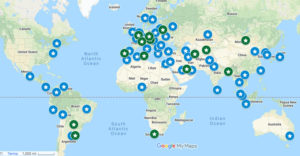
 .
.
Submissions
Submissions
1. Prepare the anonymous, 8-page (references excluded) submission using the ev2026-template following the CVPR paper guidelines.
2. Submit at cmt3.research.microsoft.com/EarthVision2026. Please submit via this link only.
Policies
A complete paper should be submitted using the EarthVision templates provided above.
Reviewing is double blind, i.e. authors do not know the names of the reviewers and reviewers do not know the names of the authors. Please read the CVPR paper guidelines for detailed instructions on how to preserve anonymity. Avoid providing acknowledgments or links that may identify the authors.
Papers are to be submitted using the dedicated submission platform: cmt3.research.microsoft.com/EarthVision2026.
The submission deadline is strict.
By submitting a manuscript, the authors guarantee that it has not been previously published or accepted for publication in a substantially similar form. CVPR rules regarding plagiarism, double submission, etc. apply.
The Microsoft CMT service was used for managing the peer-reviewing process for this conference. This service was provided for free by Microsoft and they bore all expenses, including costs for Azure cloud services as well as for software development and support.
CVPR 2026
CVPR is the premier annual computer vision event comprising the main conference and several co-located workshops and short courses. With its high quality and low cost, it provides an exceptional value for students, academics and industry researchers.