










By Joanne Van Voorhis
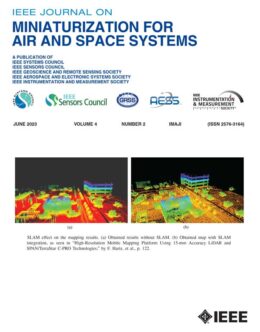
 As part of our continuing series highlighting the publications that help define communication within the IEEE Geoscience and Remote Sensing Society (GRSS), we now turn our attention to one of the Society’s newest journals. The IEEE Journal on Miniaturization for Air and Space Systems (J-MASS) was created in 2020 to serve a rapidly expanding area of research centered on compact satellites, unmanned aerial systems, and other miniaturized sensing platforms. Although young compared with many GRSS publications, J-MASS reflects one of the most significant technological trends shaping the future of Earth observation.
A New Era of Observations
For much of the history of remote sensing, Earth observation depended on large, complex, and expensive platforms. Satellites often required years of development and substantial institutional investment, while airborne systems typically involved specialized aircraft and significant operational resources. These platforms transformed our understanding of the planet while also creating practical limitations related to mission cost, development timelines, and operational flexibility.
Decades of advances in microelectronics, sensor technology, computing, and aerospace engineering have progressively transformed the capabilities of smaller sensing platforms. The emergence of CubeSats, expanded access to space through commercial launch opportunities, and the maturation of unmanned aerial systems further advanced this evolution, enabling more distributed and flexible approaches to Earth observation. Rather than relying exclusively on a small number of large instruments, many current Earth observation efforts incorporate constellations of small satellites or fleets of airborne platforms to provide more frequent observations, increased flexibility, and new mission possibilities.
Recognizing the growing importance of these technologies, IEEE launched J-MASS in 2020 as a co-sponsored publication involving the IEEE Systems Council, IEEE Geoscience and Remote Sensing Society, IEEE Aerospace and Electronic Systems Society, IEEE Vehicular Technology Society, and the IEEE Instrumentation and Measurement Society. The Journal was guided in its formation by a Steering Committee representing the participating IEEE organizations, reflecting the interdisciplinary nature of miniaturized air and space systems. This collaborative structure supported the creation of a publication focused on research spanning components, subsystems, platforms, and applications.

“J-MASS was established to serve developers, systems architects, and users of highly miniaturized airborne and spaceborne systems by connecting research across components, subsystems, platforms, and applications,” explains Editor-in-Chief Dr. Hanwen Yu. “It provides an interdisciplinary forum for advances in sensors, instrumentation, control, communications, power, propulsion, and platform integration,” he adds.
In the foreword to the inaugural June 2020 issue, founding Editor-in-Chief Roberto Sabatini highlighted the significance of the Journal launch, noting: “For the IEEE Journal on Miniaturization for Air and Space Systems (J-MASS), this is that singular moment when we achieve the first issue of what promises to be the beginning of a Journal devoted to one of the most rapidly emerging areas of technology and applications – the proliferation of small but highly capable platforms flying within the Earth’s atmosphere and without.” Topics in the first issue included “Miniaturized Solutions for CubeSat Servicing and Safety Requirements” and “Optimizing Requirements for a Compact Spaceborne Adaptive Spectral Imaging System in Subpixel Target Detection Applications.”
Beyond Miniaturization
While the Journal focuses on miniaturization, its scope extends well beyond simply making systems smaller. J-MASS emphasizes the complete lifecycle of modern sensing systems, including platform architecture, payload development, onboard processing, communications, mission planning, autonomy, and operational deployment. These components are closely interconnected because constraints on size, weight, power, and cost require engineers to optimize entire systems rather than individual technologies.
The Journal also highlights how advances in platform technology enable new scientific and operational capabilities. Articles demonstrate applications in areas such as environmental monitoring, agriculture, infrastructure inspection, disaster response, climate studies, and other domains where flexible and responsive sensing platforms can provide important advantages.
“Since 2020, increasing attention has focused on delivering greater capability under strict size, weight, power, cost, and communication constraints,” explains Dr. Yu. Recent J-MASS topics show growing interest in AI-enabled UAVs, advanced sensing and onboard data processing, cooperative operations, and miniaturized radar and SAR systems. “We welcome work linking component or algorithmic advances to the design, operation, and application of small air and space platforms,” he explains.
Editorial Leadership for an Interdisciplinary Community
Because miniaturized sensing systems bring together expertise from aerospace engineering, remote sensing, robotics, communications, embedded computing, and artificial intelligence, J-MASS serves an interdisciplinary research community. This interdisciplinary foundation is reflected not only in its technical scope but also in its governance structure.
The J-MASS Steering Committee, representing the Journal’s sponsoring IEEE organizations, provides strategic guidance and oversight for the publication. Working alongside the Editor-in-Chief and Associate Editors, the Steering Committee helps ensure that the Journal continues to reflect the needs of the diverse technical communities involved in miniaturized air and space systems.
Like all GRSS publications, the Journal depends on the contributions of volunteer reviewers and editors whose technical expertise helps ensure the quality and relevance of published research. The Journal’s Associate Editors offer expertise in areas including aerospace engineering, remote sensing, robotics, data science, and related fields.

“Because J-MASS submissions often span several technical areas, the breadth of the editorial team is essential,” explains Dr. Yu. “Associate Editors and reviewers bring complementary expertise to assess originality, technical validity, clarity, and relevance to the Journal’s scope and to miniaturized air or space systems.”
“I am sincerely grateful to the Steering Committee, Associate Editors, reviewers, authors, and sponsoring IEEE organizations. Their guidance, expertise, and service sustain the Journal’s rigorous peer-review process and help it remain responsive to a broad interdisciplinary community,” he adds.
Democratization and Accessibility
Lower development costs and standardized platforms have made advanced sensing technologies more accessible to universities, startups, small research organizations, and emerging space programs that previously faced significant barriers to developing traditional satellite missions. Researchers can now develop specialized UAV systems or participate in CubeSat missions using approaches that require fewer resources than many conventional space missions.
This broader accessibility has expanded participation in Earth observation research and created new opportunities for scientific investigation. J-MASS captures this evolution by publishing research that emphasizes scalable, cost-effective, and application-driven sensing solutions.
Integration with Emerging Technologies
Miniaturized systems increasingly incorporate artificial intelligence and advanced computing approaches for onboard data processing, which can reduce data transmission requirements and enable faster analysis in certain applications. Advances in communication networks, including inter-satellite links, are further enhancing the capabilities of distributed sensing systems.
“Taken together, these developments are changing what miniaturized platforms can do,” says Dr. Yu. “The opportunity is not simply to add AI, onboard processing, advanced sensing, or communications, but to integrate them effectively within the practical constraints of air and space systems. J-MASS provides a forum for examining this system-level integration,” he adds.
Looking Ahead
Miniaturized air and space systems continue to evolve rapidly as advances in sensing technologies, artificial intelligence, communications, and autonomous operations create new opportunities for Earth observation. Future systems will increasingly integrate smaller platforms, smarter processing capabilities, and more flexible mission architectures to address scientific, environmental, and operational challenges.
J-MASS provides a forum for this evolving research landscape by bringing together contributions across platform design, systems engineering, sensing technologies, and applications. As the field continues to mature, engagement from researchers, reviewers, and practitioners across the IEEE community will remain essential to advancing the Journal and the broader discipline it represents.
Advancing Research Through Community Contributions
As the field of miniaturized air and space systems continues to evolve, J-MASS welcomes contributions that advance the technologies, architectures, and applications shaping this area of research. J-MASS welcomes research addressing innovative approaches for the development and application of miniaturized components, subsystems, and platforms, including systems such as drones and CubeSats. The Journal’s scope encompasses sensors and components across the electromagnetic spectrum, as well as platform technologies such as propulsion, navigation, power, communications, and related systems. Contributions may address theoretical developments, practical applications, operational concepts, and the design and development of small platforms and sensing systems. The Journal also encourages work focused on educational activities involving the development of miniaturized platforms, modules, components, and sensors. J-MASS also recognizes exemplary published work. “The J-MASS Best Paper Award highlights outstanding contributions and brings them to the wider community,” says Dr. Yu.
“Looking ahead, we welcome high-quality submissions on miniaturized components, subsystems, platforms, and applications, especially work combining sound technical development with convincing validation,” encourages Dr. Yu. “The J-MASS Best Paper Award recognizes excellent published research and highlights contributions that can inspire further advances. I also encourage participation as authors, reviewers, and editors. Through broad international and interdisciplinary engagement, J-MASS can strengthen communication among its sponsoring IEEE societies and councils and advance the field,” he adds.
More details including the submission process can be found in the Authors tab at ieee-jmass.org/.
Links: