



By Joanne Van Voorhis
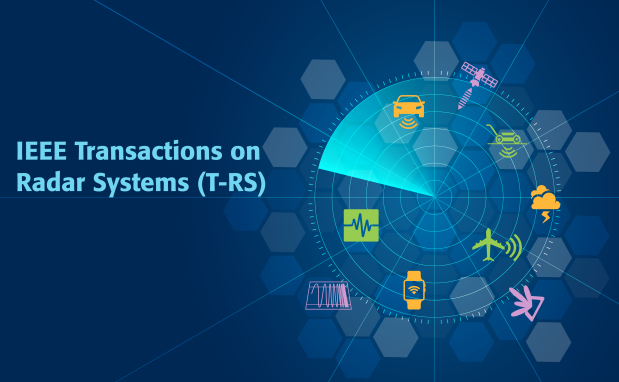 As part of our continuing series highlighting the publications that define communication within the IEEE Geoscience and Remote Sensing Society, this month we focus on one of its newest journal initiatives, IEEE Transactions on Radar Systems (T-RS). Established to provide a dedicated publication for the rapidly evolving field of radar systems, T-RS brings together research communities that have traditionally approached radar from different technical and application perspectives. Its creation reflects both the increasing breadth of radar technology and the need for a publication that can encompass that breadth.
Creating a Dedicated Radar Systems Journal
Radar has long been fundamental to sensing and remote sensing, with applications ranging from Earth observation and weather monitoring to aerospace, transportation, security, and autonomous systems. At the same time, advances in antennas, digital architectures, signal processing, imaging, machine learning, and sensing networks have expanded the field well beyond its traditional boundaries.
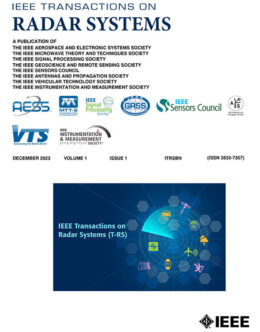
The establishment of T-RS recognized this evolution. The journal is jointly sponsored by eight IEEE organizations: the Aerospace and Electronic Systems Society, Microwave Theory and Technology Society, Signal Processing Society, Antennas and Propagation Society, Geoscience and Remote Sensing Society, Instrumentation and Measurement Society, Sensors Council, and Vehicular Technology Society.
T-RS was officially launched in October 2022, thanks to the tireless preparatory efforts of Prof. Maria Sabrina Greco (University of Pisa) and a dedicated Steering Committee. During its first three years, the journal grew under the leadership of its founding Editor-in-Chief, Prof. Shannon Blunt (University of Kansas), with the support of a dedicated Editorial Board. It provides a dedicated venue for research addressing the full radar system, from fundamental theory and electromagnetic phenomena through waveform design, hardware, signal processing, system architecture, and applications. Its scope includes radar surveillance, localization and mapping, imaging, tracking, airborne and spaceborne systems, weather and environmental radar, automotive and autonomous systems, subsurface sensing, medical and biological applications, and emerging radar technologies.

“Our sponsorship reflects the inherently interdisciplinary nature of contemporary radar research,” explains current Editor-in-Chief Fabiola Colone (Sapienza University of Rome). “The journal was created to bring the radar community together and stimulate research across disciplinary boundaries. As we guide its early growth, our focus is on fostering this exchange, supported by a steadily increasing number of contributions from research groups approaching radar challenges from diverse perspectives, including hardware, signal processing and applications,” she adds.
Bringing the Radar Community Together
A central concept behind T-RS is to provide a common forum for research that otherwise appears across numerous technical publications. Radar increasingly depends upon the interaction of disciplines: advances in antenna technology affect system architecture; new waveform and signal-processing techniques create new sensing capabilities; machine learning is changing detection and classification; and distributed and networked systems are connecting radar with communications and other sensors.
The journal’s research topics illustrate this breadth. In addition to established areas such as SAR, ISAR, InSAR, radar tracking, weather radar, automotive radar, and radar signal processing, the scope encompasses MIMO and multistatic radar, cognitive and adaptive sensing, software-defined radar, fully digital arrays, reconfigurable antennas, metamaterials, mm-wave and THz radar, low-SWaP-C systems, spectrum sharing, radar-communications integration, machine learning, and distributed sensing.
“This broad definition of radar systems is one of the journal’s distinguishing characteristics,” says Colone. “It recognizes that many of the most important developments in radar now occur at the intersections among established disciplines.”
Building the Editorial Community
The journal’s editorial structure was designed to reflect that same diversity. Fabiola Colone is supported by an Associate Editorial Board that brings together specialists from universities, research organizations, government laboratories, and industry across an international range of institutions. The steering committee likewise represents the eight sponsoring organizations and provides a mechanism for maintaining coordination among the communities responsible for the journal. Greg Lyons of MIT Lincoln Laboratory serves as chair, with Xiaofeng Li of the Chinese Academy of Sciences representing GRSS.
“The volunteers behind T-RS provide the foundation for the work we do,” explains Colone.” “Particularly during the journal’s formative stages, we have made a deliberate effort to build an editorial board whose members combine extensive editorial experience with recognized standing in their respective research fields. By working closely as a team, we have been able to draw on this diversity to define the journal’s scope and establish clear expectations for the quality of its contributions. Our collective challenge is to maintain a publication broad enough to represent the radar community while preserving the technical rigor and standards expected of an IEEE Transactions,” she adds.
Early Contributions and Accomplishments
 The first issue, published in December 2023, demonstrated the breadth of research the new journal was intended to accommodate. It included work on automatic dynamic estimation of on-orbit satellites using spaceborne ISAR imaging, direction-of-arrival deception using time-modulated scatterers, and methods for assessing Doppler tolerance.
Since then, T-RS has continued to establish its presence as a publication serving both established and emerging areas of radar research. The journal has moved fairly rapidly from its establishment toward the broader goal of creating a sustained international research community around radar systems.
“The journal recently received its first Impact Factor of 3.5, and we expect this figure to rise considerably in the coming years as we see a growing number of high-quality submissions,” says Colone. “This growth is also supported by the journal’s strong record of timely editorial decisions and publication since its launch, with submission-to-first-decision and submission-to-publication times consistently placing it among the best-performing IEEE journals,” she explains.
Contributing to T-RS
Authors interested in publishing in IEEE Transactions on Radar Systems can submit either regular papers or correspondence items. Regular papers are to be a well-rounded treatment of a problem area. The title, abstract, and introduction should be sufficiently informative to illuminate the essence of the manuscript to the broadest possible audience and to place the contributions in context with related work. The body of the manuscript should be understandable without undue effort by its intended audience. The distinction between regular papers and correspondence is not one of quality but of nature. Whereas a regular paper is a well-rounded treatment of a problem area, a correspondence item concisely makes one or two points.
Submissions must present original research, and expanded versions of conference papers may also be considered. All manuscripts which pass preliminary approval undergo peer review by at least two independent reviewers. More information for authors is available online (ieee-trs.org/author-information).
Looking Ahead
T-RS is undergoing substantial technological change. Digital arrays, advanced waveform design, artificial intelligence, distributed sensing, new frequency regimes, reconfigurable systems, and radar-communications integration are expanding both the capabilities and applications of radar.
“The enthusiasm our team has for this new Journal is understandable,” says Colone. “It represents not simply the addition of a new IEEE publication, but a recognition that radar has evolved into a broad systems discipline requiring a correspondingly broad and collaborative forum. In its first years, T-RS has begun building that forum—and we are dedicated to supporting the radar community as it evolves and grows,” she adds.
As to the future, Colone says the challenge is to ensure that researchers working across the full breadth of radar research see IEEE Transactions on Radar Systems as a natural home for their work. “Over the next several years, we hope to see an ever-growing community contribute to its development, both by submitting their research and by taking an active role in peer review – as reviewers and, for those further along in their careers, as volunteer Associate Editors,” says Colone. “We are also developing an annual Best Paper Award, and we look forward to recognizing our authors’ outstanding contributions to the field,” she adds.
Links: