









By Kevin P. Corbley
 Tomorrow.io is a commercial company that is successfully breaking the barrier to weather data with the goal of improving upon the forecasting capabilities that were traditionally the sole domain of government entities. The Boston-based company is achieving this by following a blueprint similar to commercial Earth observation – leveraging small satellite technology and rapidly declining launch costs.
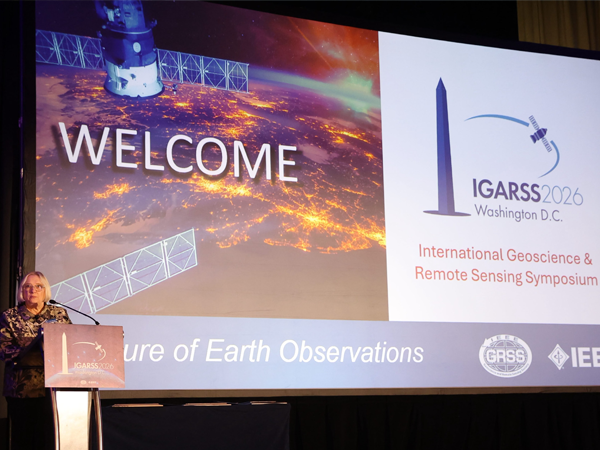
In a featured IGARSS 2026 Plenary address entitled “Breaking the Data Barrier: How Commercial Weather Satellites Will Change Everything,” Tomorrow.io’s chief strategy officer Rei Goffer described the company’s journey. In just 10 years, Tomorrow.io has grown from a startup to a leader in weather intelligence with $500 million in funding to date, 13 satellites in orbit, and hundreds of paying customers.
Goffer started his talk by describing his own background. He made it a point to say he isn’t an engineer. Rather, his educational background is in business and economics and before that he was a navigator in an Israeli fighter jet. From this he gained an appreciation for quality weather information. And his education helped him focus on the societal and economic impacts of his work as a primary motivating influence.
As an example of what motivates the entire Tomorrow.io team, Goffer showed a world map depicting weather radar coverage. Since its invention in the 1940s, ground-based radar covers only about 10 percent of the globe. Unfortunately, the vast majority of the world’s one billion people who depend on small-holder farms for livelihood reside in the gaps, which also coincide with some of the Earth’s most volatile weather.
Tomorrow.io seeks to fill in those gaps both geographically and temporally with hyper-local weather intelligence.
The company has clearly filled a need that government could not. Its hundreds of customers include civilian and defense agencies worldwide, while its commercial clients come from industries such as aviation, rideshare, transportation, mining, and energy. The first constellation of satellites already launched will be joined, or replaced by, dozens more on the drawing board.
“What we do as a company at a very high level is full stack technology from generating proprietary data observations of the atmosphere, developing and running AI-based models, and then delivering business intelligence to our customers, also using AI,” Goffer said.
Data is the key. The Tomorrow.io team realized that existing weather forecasting models had been greatly improved by AI technology, but the models were only as good as the training data fed into them. At the time, available training data was extremely limited. The company set out to design a constellation of satellites capable of capturing large volumes of data with frequent revisit.
The current satellite constellation combines active radar with passive microwave sounder instruments to collect a diversity of atmospheric data, including precipitation and water vapor measurements.
Goffer pointed out the company completed development of the first constellation and had it operational in orbit in about three years. He noted this is an example of how quickly a private company can innovate compared with a government agency that must go through layers of permission levels to sign off on design changes. However, he was also quick to note that Tomorrow.io is building on science proven by NASA and NOAA research.
The next constellation called DeepSky is already under development at Tomorrow.io. The goal is to launch additional satellites with an even more diverse array of sensors – microwave sounders, precipitation radar, visible and IR imagers and others. The company plans to capture radar data worldwide every hour.
With hundreds of satellites eventually collecting dozens of different data points and feeding them in near-real-time into global AI models every 15 minutes, DeepSky will be a gamechanger. Goffer encouraged the IGARSS attendees to imagine the positive impact such temporal information would have on predicting the movements of floods, wildfires, and typhoons.
“Sounds like science fiction, [but] it’s possible when we have the data to do that,” Goffer concluded.