


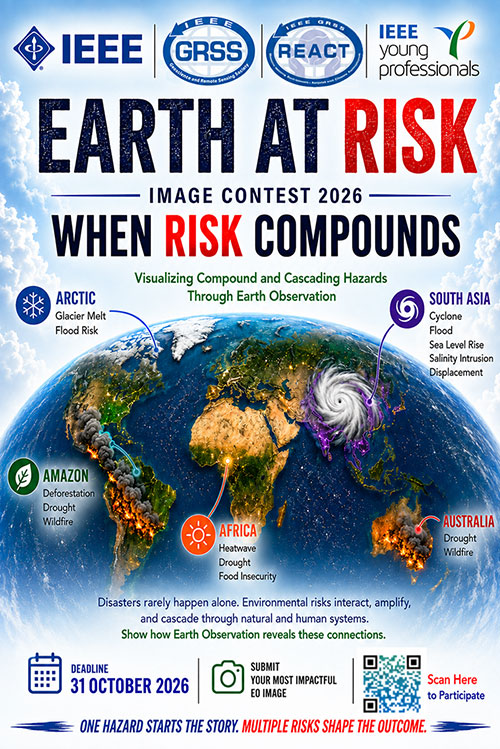
“Earth at Risk” Image Contest 2026
Background
The “Earth at Risk” Image Contest, organized by IEEE GRSS Young Professions and Technical Committee REACT, has established itself as a global platform for showcasing the power of Earth Observation (EO), remote sensing, and geospatial technologies in communicating environmental challenges and disaster impacts. Previous editions have highlighted floods, wildfires, droughts, earthquakes, environmental degradation, and climate-related crises through compelling EO imagery and visual storytelling.
As climate change accelerates and human pressures on natural systems continue to grow, understanding these interconnected risks has become one of the most pressing challenges in disaster risk reduction and sustainable development. EO technologies provide a unique opportunity to visualize these interactions, reveal cascading impacts, and communicate the complexity of modern environmental risk. However, disasters rarely occur as isolated events. Increasingly, environmental risks emerge from the interaction of multiple hazards, human activities, and underlying environmental conditions. A cyclone striking a rapidly urbanizing region may result in catastrophic flooding. Drought combined with deforestation can intensify wildfire risk. Sea-level rise, coupled with groundwater extraction and coastal development, can accelerate salinity intrusion and coastal vulnerability.
Proposed Theme – Earth at Risk 2026: When Risks Collide
Theme Rationale
Traditional disaster imagery often focuses on a single hazard and its immediate impacts. While valuable, such representations may overlook the interconnected processes that drive modern disasters.
The proposed theme encourages participants to explore how risks interact across environmental and human systems. The focus is not only on hazards themselves but also on the relationships between: Hazard & Hazard, Hazard & Human Activity, Hazard & Environmental Degradation, Hazard & Vulnerability and Multiple interacting drivers producing cascading impacts.
The theme recognizes that the most severe disasters frequently emerge when natural processes intersect with human pressures and existing vulnerabilities. By encouraging participants to visualize these interactions, the competition aims to move beyond event-based disaster imagery and toward systems-based environmental storytelling.
Proposed Competition Enhancements
To further strengthen the impact and originality of the 2026 edition, the following addition is proposed:
Narrative Caption Component
Participants submit a concise explanatory narrative (100–150 words) describing:
- the environmental issue,
- EO methodology,
- societal relevance,
- and significance of the observed change.
This will enhance science communication and public accessibility.
Objectives
The 2026 edition aims to:
- Highlight the role of Earth Observation in understanding interconnected environmental challenges.
- Encourage innovative visual storytelling that captures complex interactions between natural and human systems.
- Demonstrate how EO technologies can support integrated approaches to disaster risk reduction and climate resilience.
Suggested Topics
Participants may explore, but are not limited to, the following examples:
- Hazard + Hazard
- Hazard + Human Activity
- Hazard + Environmental Change
- Cascading Risks
Selection Process
Images and accompanying explanations will be evaluated by environmental geoscience and remote sensing experts from the IEEE GRSS YP, REACT Technical Committee and experts working in this domain, who will determine the winners except for the Public Choice Award.
For the Public Choice Award, all entries that accepted the terms of use will be open to public voting during October 2026.
The selection criteria are:
- Scientific relevance
- Visual storytelling
- Originality and creativity
- Societal and environmental impact
- Technical quality
Deadline
October 31st, 2026
Prizes
The top 3 images selected by the jury will be awarded attractive prizes in the value of:
- 600 USD for first place,
- 450 USD for second place,
- 350 USD for third place,
along with Certificates of Achievement from IEEE GRSS.
The Public Choice winner will also receive a prize valued at 600 USD.
Additionally, a special recognition may be awarded for:
- Best Visual Storytelling,
- Best Student Submission,
- and Public Impact.
Selected finalists may also feature in future digital and print material from IEEE GRSS and may be invited to present their work during IEEE GRSS REACT-TC events and workshops.
The winners will be notified by email by the end of October 2026. Therefore, please ensure that correct contact information is provided in the submission form.
How to Participate
Submit your image using the official submission form.
If you would like to participate in the Public Choice Award, you may post your image on social media using the hashtags: #EarthAtRisk #IEEEGRSS #REACTTC and tag:
@IEEE_GRSS and @GRSSYP
Submission Requirements
Each submission must include:
- Image Caption – A short caption of 50–100 words describing: the environmental issue or hidden pattern being highlighted, the significance of the observed change, and the story behind the image. The caption should complement the visual narrative and be understandable to both scientific and public audiences.
- Technical Note – Participants may additionally include a brief technical note (maximum 150 words) summarizing: the EO data used, processing methodology, indices or analytical approaches applied, and relevant visualization techniques. The technical note is intended to support the scientific context of the submission without overwhelming the visual storytelling component.
Image Rules
- Formats allowed: electronic formats (.jpeg, .png, .tiff, .gif, etc.)
- Each entry must be the submitting entrant’s original work.
- Entries should not contain copyrighted material owned by third parties unless proper permissions are obtained.
- Team submissions are permitted; however, teams must appoint one representative for communication and prize distribution.
- The entry and accompanying narrative must be submitted in English.
Proposed Evaluation Criteria
Criteria | Weight |
Scientific Relevance | 30% |
Visual Storytelling | 25% |
Originality and Innovation | 20% |
Societal Relevance | 15% |
Technical Quality | 10% |
Expected Outcomes
The proposed theme is expected to:
- broaden the scientific scope of the competition,
- encourage systems-based thinking in disaster and climate risk communication,
- promote innovative EO applications for compound and cascading risk analysis,
- attract interdisciplinary global participation,
- strengthen public understanding of interconnected environmental challenges,
- and position Earth at Risk as a leading platform for visualizing complex environmental risks through geospatial science.
Conclusion
“Earth at Risk 2026: When Risks Collide” represents an evolution of the competition from visualizing individual hazards to understanding the interactions that shape disaster outcomes. By focusing on the relationships between hazards, human activities, environmental change, and vulnerability, the competition highlights the unique ability of Earth Observation technologies to reveal the complex and interconnected risks facing our planet.