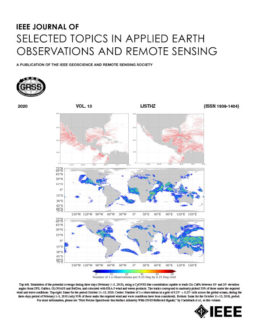













IEEE Journal of Selected Topics in Applied Earth Observations and Remote Sensing

The “IEEE Journal of Selected Topics in Applied Earth Observations and Remote Sensing” (JSTARS) is a new quarterly publication sponsored by the IEEE Geoscience and Remote Sensing Society (GRSS) and co-sponsored by the IEEE Committee on Earth Observations (ICEO).

The new Journal reflects the growing interest in application themes in the annual IEEE conferences as well as the increasing involvement of GRSS in the ICEO. A new journal was envisaged as a communication and outreach medium for these applications themes.

The ICEO is a committee of the Technical Activities Board of IEEE (TAB). The ICEO includes the interests of several IEEE committees and councils, and members have taken leadership roles in activities of the Global Earth Observations System of Systems (GEOSS). A new journal has been part of the development plan of ICEO from its inception. A partnership between GRSS and ICEO on developing the new journal has been an obvious opportunity and, from the beginning, both groups have collaborated on the planning for the new cosponsored journal. It will be a venue for peer reviewed papers on a variety of application themes in earth observations and remote sensing of relevance to the membership of both groups.

In addition, GRSS has seen the publication of the Transactions on Geoscience and Remote Sensing increase to 3736 pages and 343 articles in 2006. Many papers are part of special issues that result from GRSS sponsored or cosponsored symposia and workshops and similar initiatives. The increasing demand for special issues (seven printed and planned for 2007) will soon strain the editorial and review process. Some special issue topics, particularly those that fall in the applications area, will now be published by the new JSTARS to ease this load.

We welcome individual articles and proposals for theme issues or special issues on topics relevant to JSTARS.
In developing the scope of the journal the initiatives of the ICEO have been reviewed and a survey of the GRSS membership and interested parties has been conducted. The following defines the range of issues appropriate for JSTARS: “Papers should address current issues and techniques in applied remote and in situ sensing, their integration, and applied modeling and information creation for understanding the Earth. Applications are for the Earth, oceans and atmosphere.

Topics can include observations, derived information such as forecast data, simulated information, data assimilation and Earth information techniques to address science and engineering issues of the Earth system. The technical content of papers must be both new and significant.”

Editor-in-Chief:
chanuss Name:Dr. Jocelyn Chanussot, SM IEEE
Institution:GIPSA-Lab, Grenoble Institute of Technology
Location:Grenoble, France
Contact: jocelyn.chanussot@gipsa-lab.grenoble-inp.fr

Bio: Chanussot received the M.Sc. degree in electrical engineering from the Grenoble Institute of Technology (Grenoble INP), Grenoble, France, in 1995, and the Ph.D. degree from Savoie University, Annecy, France, in 1998. In 1999, he was with the Geography Imagery Perception Laboratory for the Delegation Generale de l’Armement (DGA – French National Defense Department). Since 1999, he has been with Grenoble INP, where he was an Assistant Professor from 1999 to 2005, an Associate Professor from 2005 to 2007, and is currently a Professor of signal and image processing. He is currently conducting his research at the Grenoble Images Speech Signals and Automatics Laboratory (GIPSA-Lab). His research interests include image analysis, multicomponent image processing, nonlinear filtering, and data fusion in remote sensing.

Dr. Chanussot is the founding President of IEEE Geoscience and Remote Sensing French chapter (2007-2010) which received the 2010 IEEE GRS-S Chapter Excellence Award “for excellence as a Geoscience and Remote Sensing Society chapter demonstrated by exemplary activities during 2009”. He was a member of the IEEE Geoscience and Remote Sensing AdCom (2009–2010), in charge of membership development. He was the General Chair of the first IEEE GRSS Workshop on Hyperspectral Image and Signal Processing, Evolution in Remote sensing (WHISPERS). He is the Chair (2009-2011) and was the Cochair of the GRS Data Fusion Technical Committee (2005–2008). He was a member of the Machine Learning for Signal Processing Technical Committee of the IEEE Signal Processing Society (2006–2008) and the Program Chair of the IEEE International Workshop on Machine Learning for Signal Processing, (2009). He was an Associate Editor for the IEEE GEOSCIENCE AND REMOTE SENSING LETTERS (2005–2007) and for Pattern Recognition (2006–2008). Since 2007, he is an Associate Editor for the IEEE TRANSACTIONS ON GEOSCIENCE AND REMOTE SENSING.

Deputy Editor-in-Chief:
ells Name:Dr. Ellsworth LeDrew, FIEEE, FCASI
Institution:Faculty of Environmental Studies, University of Waterloo,
Location:Ontario, Canada
Contact: ells@watleo.uwaterloo.ca
Bio: Ellsworth LeDrew is a Professor in the Department of Geography and Environmental Management of the Faculty of Environment at the University of Waterloo, Ontario, Canada. He received his PhD in 1976 and MA in 1974 from the University of Colorado and BA in 1972 from the University of Toronto. He was appointed University Research Chair in 2002 and University Professor in 2009.

Dr. LeDrew is a Fellow of the IEEE and a Fellow of the Canadian Aeronautics and Space Institute. In 2005 he was awarded the Gold Medal by the Canadian Remote Sensing society. He has supervised 18 PhD students and 30 Masters students.

Research interests include climate-cryosphere interactions using Passive Microwave imagery and numerical climate models, the exploration of high spectral and spatial resolution imagery for analysis of environmental stress on tropical coral reefs, the use of earth observations in international energy management, and data management, discovery and archiving for Polar Environmental Science.

Jocelyn Chanussot received the M.Sc. degree in electrical engineering from the Grenoble Institute of Technology (Grenoble INP), Grenoble, France, in 1995, and the Ph.D. degree from Savoie University, Annecy, France, in 1998. In 1999, he was with the Geography Imagery Perception Laboratory for the Delegation Generale de l’Armement (DGA – French National Defense Department). Since 1999, he has been with Grenoble INP, where he was an Assistant Professor from 1999 to 2005, an Associate Professor from 2005 to 2007, and is currently a Professor of signal and image processing. He is currently conducting his research at the Grenoble Images Speech Signals and Automatics Laboratory (GIPSA-Lab). His research interests include image analysis, multicomponent image processing, nonlinear filtering, and data fusion in remote sensing.

Dr. Chanussot is the founding President of IEEE Geoscience and Remote Sensing French chapter (2007-2010) which received the 2010 IEEE GRS-S Chapter Excellence Award “for excellence as a Geoscience and Remote Sensing Society chapter demonstrated by exemplary activities during 2009”. He was a member of the IEEE Geoscience and Remote Sensing AdCom (2009–2010), in charge of membership development. He was the General Chair of the first IEEE GRSS Workshop on Hyperspectral Image and Signal Processing, Evolution in Remote sensing (WHISPERS). He is the Chair (2009-2011) and was the Cochair of the GRS Data Fusion Technical Committee (2005–2008). He was a member of the Machine Learning for Signal Processing Technical Committee of the IEEE Signal Processing Society (2006–2008) and the Program Chair of the IEEE International Workshop on Machine Learning for Signal Processing, (2009). He was an Associate Editor for the IEEE GEOSCIENCE AND REMOTE SENSING LETTERS (2005–2007) and for Pattern Recognition (2006–2008). Since 2007, he is an Associate Editor for the IEEE TRANSACTIONS ON GEOSCIENCE AND REMOTE SENSING.

Articles & Announcements

Objective Detection of Center of Tropical Cyclone in Remotely Sensed Infrared Images

In the present work, an objective technique has been presented to fix the center position of TC in the satellite generated infrared images. The basis of the technique is to determine the point around which the fluxes of the gradient vectors of brightne…

Read More »

Impact of Moisture Distribution Within the Sensing Depth on L- and C-Band Emission in Sandy Soils

The performances of the soil moisture retrieval and assimilation algorithms using microwave observations rely on realistic estimates of brightness temperatures $({rm T}_{rm B})$ from microwave emission models. This study identifies circumstances when c…

Read More »

Assessment of the Radiometric Performance of Chinese HJ-1 Satellite CCD Instruments

Data from the Chinese Huan-Jin (which means “environment”) 1 satellites, HJ-1A and HJ-1B, have been widely used for environmental, disaster monitoring and other applications. However, the radiometric properties of their CCD sensors have n…

Read More »

Toward an Operational Bare Soil Moisture Mapping Using TerraSAR-X Data Acquired Over Agricultural Areas

TerraSAR-X data are processed for an “operational” mapping of bare soils moisture in agricultural areas. Empirical relationships between TerraSAR-X signal and soil moisture were established and validated over different North European agri…

Read More »

Contextual Subpixel Mapping of Hyperspectral Images Making Use of a High Resolution Color Image

This paper describes a hyperspectral image classification method to obtain classification maps at a finer resolution than the image’s original resolution. We assume that a complementary color image of high spatial resolution is available. The proposed …

Read More »

[Front cover]

Presents the front cover for this issue of the publication.

Read More »

An Approach for Subpixel Anomaly Detection in Hyperspectral Images

Fast detecting difficult targets such as subpixel objects is a fundamental challenge for anomaly detection (AD) in hyperspectral images. In an attempt to solve this problem, this paper presents a novel but simple approach based on selecting a single fe…

Read More »

Construction and Experiment of Hierarchical Bayesian Network in Data Assimilation

A Hierarchical Bayesian Network Algorithm (HBN) is developed for data assimilation and tested with an instance of soil moisture assimilation from hydrological model and ground observations. In essence, HBN is a framework that can statistically describe…

Read More »
  • latest issue
  • Table of Contents
  • Related Information

    View the most popular JSTARS articles.

  • Submission Information

    Paper submission is handled through the Manuscript Central site (mc.manuscriptcentral.com/jstars). The work flow for submission and review is the same as that for TGRS.

    We welcome individual articles and proposals for theme issues or special issues on topics relevant to JSTARS. Further information and guidance is available by contacting either the Editor-in-Chief or the Deputy Editor-in-Chief. We look forward to collaborating with the membership on an important and exciting new chapter in the evolution of both the GRSS and ICEO.

  • Submit Your Paper